
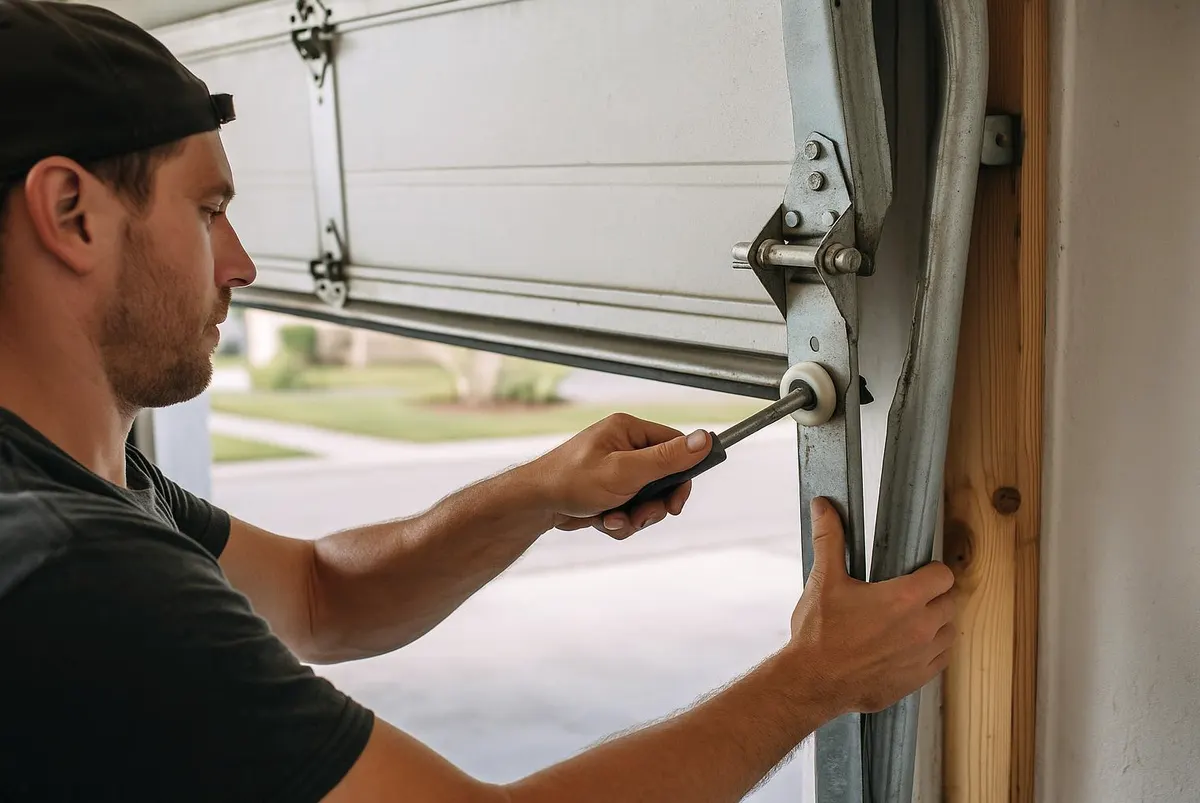
What a Technician Usually Finds
Most calls about this start the same way: a homeowner presses the remote, the door starts down, then stops a foot off the ground and reverses right back up. Sometimes it won't even try to close at all. Nine times out of ten, the culprit is a pair of small plastic sensors mounted a few inches off the floor on either side of the garage door track. These are the photo-eye safety sensors, and in a humid, salt-heavy coastal environment like this one, they're one of the most common reasons we get called out.
On a typical visit, we'll find one sensor knocked slightly out of alignment, a hazy film of salt residue or moisture on the lens, or a spiderweb strung right across the beam. Any of these can be enough to interrupt the signal and send the opener into reverse.
How Photo-Eye Sensors Work (and Why They're Not Optional)
The two sensors face each other across the bottom of the door opening, sending an invisible infrared beam between them. As long as that beam is unbroken, the opener knows it's safe to close the door. If something - a pet, a toy, a foot, a stack of boxes - breaks the beam while the door is coming down, the sensors signal the opener to stop and reverse immediately.
This system exists because garage doors are heavy, and a door closing on a person or animal can cause serious injury. It's a required safety feature on every opener manufactured for residential use, and it's not something to disable, tape over, or ignore just because it's acting up.
Why Coastal Weather Makes This Worse
A few conditions specific to this area make photo-eye problems more frequent than they'd be inland:
- Salt air corrosion: Salt carried in off the Gulf settles on exposed metal and plastic surfaces, including sensor lenses and their mounting brackets. Over time it can corrode wiring connections or leave a film that scatters the infrared beam.
- Humidity and condensation: After a hot, humid day followed by an afternoon downpour, moisture can fog the sensor lenses or seep into connection points, especially if a wire nut or splice isn't fully sealed.
- Storm-season vibration: Tropical storms and heavy wind during hurricane season can rattle door tracks and brackets just enough to nudge a sensor out of true alignment, even if nothing looks visibly damaged.
- Bugs and debris: Warm, humid garages attract spiders and insects. Webs spun across the sensor beam, or dirt and lawn clippings kicked up during mowing, are common everyday interruptions.
Signs Your Photo-Eyes Need Attention
- The door reverses before touching the floor, every time or intermittently
- The door won't close at all, and the opener's wall control light blinks a repeating pattern
- The door only closes when you hold the wall button down continuously (this bypasses the safety reverse and should be treated as a red flag, not a workaround)
- One sensor's indicator light is dim, flickering, or off entirely
- The door behaves differently depending on the time of day, which often points to sun glare or condensation affecting the beam
How to Clean and Align Them Yourself
Before assuming you need a new opener or a service call, it's worth checking the sensors yourself. This takes about ten minutes:
- Locate both sensors. They sit a few inches above the floor on the inside of each vertical track, usually with a small LED light on each unit.
- Wipe the lenses. Use a soft, dry cloth or a lightly dampened microfiber cloth. Avoid household glass cleaners, which can leave a residue that attracts more grime in humid air.
- Clear the beam path. Remove any boxes, tools, hoses, or stray branches from the floor between the two sensors.
- Check for visible misalignment. The brackets should point directly at each other. If one looks tilted or has been bumped (a common result of lawn equipment, bikes, or storm debris), gently loosen the wing nut or mounting screw and adjust it.
- Watch the indicator lights. Most sensors show a solid light when properly aligned and a flickering or dark light when the beam is interrupted. Adjust slowly until both lights are steady.
- Test the door. Run it up and down a few times to confirm it closes fully without reversing.
If the lenses are clean, the alignment looks correct, and the door still won't close properly, the issue is likely deeper, such as corroded wiring, a failing sensor unit, or a problem with the opener's logic board rather than the sensors themselves.
Why You Should Never Bypass Them
Some older opener models can be manually overridden to ignore the sensors entirely, and some homeowners resort to holding the wall button to force a close. Both approaches remove the one safety mechanism standing between a closing door and a child, pet, or adult who steps into its path. A door that won't close because of a dirty lens is an inconvenience. A door that closes on someone because the sensors were disconnected is a preventable injury. If your sensors keep failing, the fix is diagnosing and repairing them, not working around them.
When to Call Bradenton Beach Garage Door Experts
If you've cleaned the lenses, checked the alignment, and the door still reverses or won't close, it's time to call in a technician. We can trace wiring for corrosion damage from salt air, replace a failed sensor unit, or realign brackets that have shifted after storm season. This kind of check is also a standard part of our Garage Door Maintenance & Tune-Up service, and if the sensor trouble turns out to be connected to a track that's bent or knocked loose, our Off Track Door Repair service addresses that at the source.
If your garage door in Bradenton Beach, FL is reversing, blinking, or refusing to close, give Bradenton Beach Garage Door Experts a call for fast, honest diagnosis and repair.