
The Short Answer
Most loud garage door noise comes from loose hardware, dry metal rollers, or a chain-drive opener that's simply doing its job the noisy way. You can fix the first two yourself in under an hour with basic tools. If the racket is coming from the opener motor itself, or if a tune-up doesn't quiet things down, the real fix is a belt-drive conversion — and that's a job for a technician.
Tools You'll Need
- Socket wrench or ratchet set
- Lithium-based garage door lubricant (not WD-40 or household oil)
- Rubber isolator kit for the opener motor mount
- Replacement nylon rollers (if yours are metal and worn)
- Step ladder
- Work gloves and safety glasses
Step-by-Step: Quieting a Loud Garage Door Opener
- Step 1: Figure out what kind of noise you're dealing with. Grinding usually means dry or worn rollers. Rattling points to loose hardware. A loud bang on open or close often means the opener's travel limits need adjusting. A low hum or buzz from the motor housing itself is a sign the opener's internal gears or chain are worn, not something a quick fix will solve.
- Step 2: Tighten every bolt and screw you can reach. Garage doors flex every time they open and close, and in this climate the humidity makes wood door frames swell and shrink, which loosens mounting hardware faster than it would inland. Go along the tracks, hinges, and the opener's ceiling bracket with a socket wrench and snug everything up. This alone quiets a surprising number of doors.
- Step 3: Lubricate the moving metal parts. Hinges, rollers, and the torsion spring all need a coat of lithium-based grease a few times a year — more often here, since salt air speeds up surface rust on exposed hardware near the coast. Skip WD-40; it's a solvent, not a lubricant, and it attracts grit.
- Step 4: Swap worn metal rollers for nylon ones. If your rollers are the original steel ones, they're almost certainly contributing to the noise. Nylon rollers run quieter, don't need as much lubrication, and hold up better against rust. Replacing them is a moderate DIY job: remove the roller bracket, slide the old roller out, slide the new one in. Do one at a time so the door stays supported.
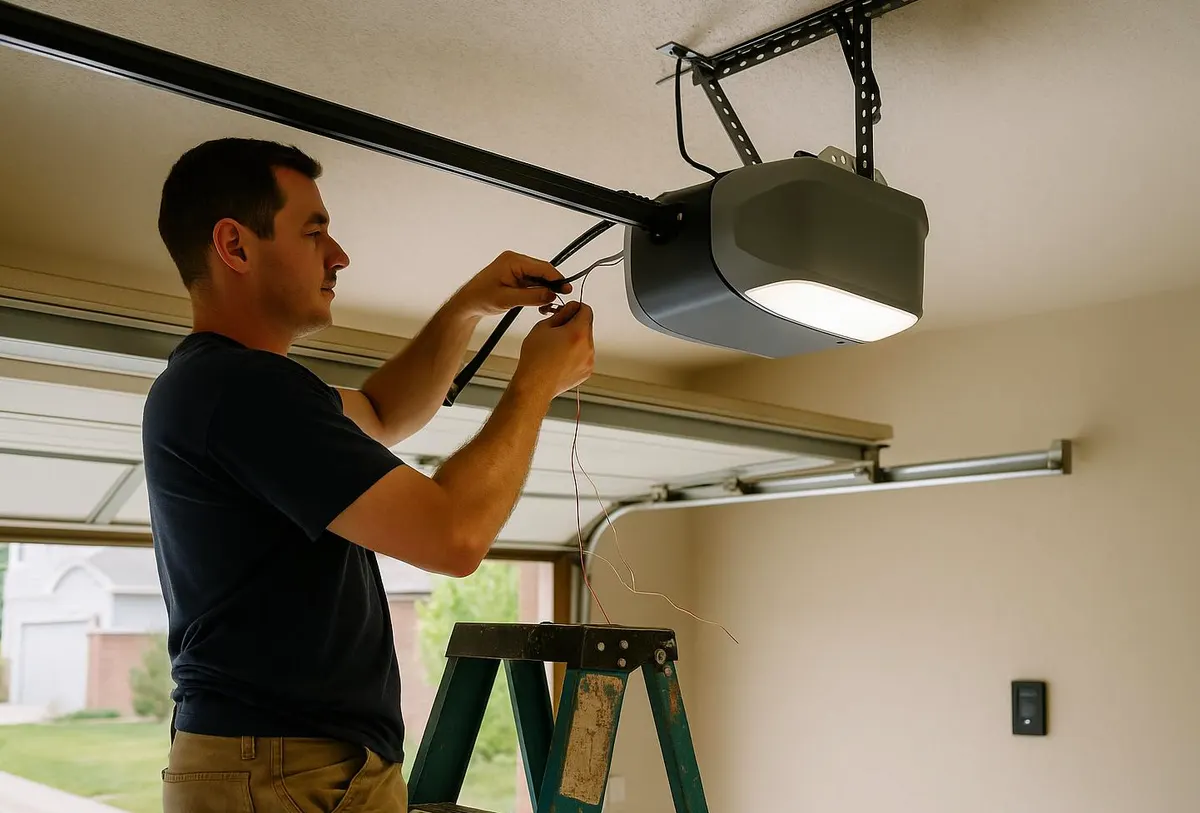
- Step 5: Add rubber isolators where the opener mounts to the ceiling. A chain-drive opener bolted directly to a ceiling joist transmits every vibration into your attic and walls, which is why the noise often sounds louder inside the house than in the garage. A simple rubber isolator kit between the motor unit and its mounting bracket cuts a lot of that transferred vibration for under $20.
- Step 6: Check and adjust chain or belt tension. A chain that's too loose slaps against the rail with every cycle. Most openers have a tensioning bolt near the motor head — consult your opener's manual, since over-tightening puts strain on the motor.
- Step 7: Inspect springs and cables, but don't touch them. If the noise is a sharp bang or pop near the top of the door's travel, that can point to a spring under uneven tension or a cable starting to fray. These parts are under enough load to cause serious injury if handled wrong, so this step is diagnosis only — fixing it is a technician's job.
- Step 8: If it's still loud, it's time for a belt-drive swap. Chain-drive openers are mechanically noisy by design — metal chain on a metal rail. A belt-drive opener replaces that chain with a reinforced rubber belt, which is dramatically quieter and holds up well in humid, salt-air conditions. This is a full opener swap, including rewiring the safety sensors and setting travel limits correctly, which makes it a technician install rather than a weekend project.
Where This Gets Local
Homes on Anna Maria Island and along the coast deal with two things that make opener noise worse over time: salt air that corrodes exposed rollers, hinges, and chain links faster than it would further inland, and wind-load-rated doors that are heavier than standard doors and put more strain on a standard chain-drive motor. If your door was upgraded for storm resistance, upgrading the opener to handle that extra weight quietly is often worth doing at the same time.
When to Call Bradenton Beach Garage Door Experts
If you've tightened, lubricated, and swapped rollers and the door is still loud — or if you heard a bang and saw a frayed cable or an odd kink in a spring — stop troubleshooting and call us. We handle Garage Door Opener Installation for homeowners ready to move to a quieter belt-drive system, and our Garage Door Maintenance & Tune-Up service covers the full inspection: springs, cables, tracks, and hardware, with everything adjusted and lubricated for our coastal climate.
If your garage door opener is driving you up the wall, give Bradenton Beach Garage Door Experts a call. We serve Bradenton Beach, Holmes Beach, Anna Maria, Longboat Key, Cortez, Bradenton, Palmetto, and Sarasota with fast, honest service.